But you, Bethlehem Ephrathah— least among the clans of Judah— from you will come out to Me One to be ruler in Israel, One whose goings forth are from of old, from days of eternity.
Micah 5:1 TLV
“Behold, days are coming” —it is a declaration of Adonai— “when I will raise up for David a righteous Branch, and He will reign as king wisely, and execute justice and righteousness in the land. In His days Judah will be saved, and Israel will dwell in safely; and this is His Name by which He will be called: Adonai our righteousness.
Jeremiah 23:5-6 TLV
“Behold, days are coming” —it is a declaration of Adonai— “when I will make a new covenant with the house of Israel and with the house of Judah…
This is the covenant I will make with the house of Israel after those days” —it is a declaration of Adonai— “I will put My Torah within them. Yes, I will write it on their heart. I will be their God and they will be My people.
Jeremiah 31:30&32 TLV
“Behold, days are coming” —it is a declaration of Adonai— “when I will fulfill the good word I spoke concerning the house of Israel and concerning the house of Judah. In those days and at that time, I will cause a Branch of Righteousness to spring up for David, and He will execute justice and righteousness in the land. In those days will Judah be saved, and Jerusalem will dwell safely. And this is the Name by which she* will be called: Adonai our Righteousness.”
Jeremiah 33:14-16 TLV – *(Translation revised to reflect the Hebrew pronoun “she”, referring to the city of Jerusalem in Israel. Source: Hebrew Interlinear
For this reason He (Jesus) is the mediator of a new covenant, in order that those called may receive the promised eternal inheritance—since a death has taken place that redeems them from violations under the first covenant. For where there is a covenant, the death of the one who made it must be established.
Hebrews 9:15-16 TLV
I say then, they (Israel) did not stumble so as to fall, did they? May it never be! But by their false step salvation has come to the Gentiles, to provoke Israel to jealousy. Now if their transgression leads to riches for the world, and their loss riches for the Gentiles, then how much more their fullness! But I am speaking to you who are Gentiles…
For if their rejection leads to the reconciliation of the world, what will their acceptance be but life from the dead?
Romans 11:11-13 & 15 TLV
Hello Friends,
For many Christians, especially in the West, Christmas is a time of celebration and reflection concerning the birth of our Lord and Savior, Jesus of Nazareth. As someone with a love for Israel, and the promises which God has spoken over the Jewish people, the current war is certainly not a cause for celebration, and the conflict looms over my own thoughts going into the Christmas season.
As violence fills the streets of our Lord and Savior’s covenantal lands, the Western world prepares to celebrate one of our main religious holidays of the year. At Christmas, we celebrate “peace to all and goodwill towards men”. In light of this Messianic promise of peace, I realize there is no better time to be praying the great prayers of faith, “O, Come, O Come, Emmanuel”. May His peace and goodwill touch the beautiful land and ethnic countrymen of our Messiah!
Additionally, in light of the Israel war with Hamas, I believe this is also a divine moment to reflect on the truth of the New Covenant, which, if you read the verses above, is a promise given to the people of Judah and Israel. This reflection leads me to 2 questions:
What can we, as believers in the New Covenant promises of Scripture, do to ensure Jewish acceptance into these promises made by the Hebrew prophets so long ago?
What can I do, as an individual, to rightly understand these promises and faithfully cling to them?
While there are certainly variations of interpretation in the modern church regarding the nature of the New Covenant, very few of those interpretations focus on the actual text within the prophet Jeremiah in regards to the promises given uniquely to a redeemed, reunified, and restored Israel.
The more popular interpretations present in our churches today seem to emphasize the idea that we are currently living in a time of history where the church is experiencing the benefits of the New Covenant, while Israel is currently cut off from the New Covenant. This is simply not true or biblical. We are wrong if we believe that we are currently living in New Covenant times under the full effect of New Covenant promises, because it is the salvation of all Israel which allows us access to the full benefits of the New Covenant.
Allow me to explain.
The New Covenant was cut (initiated) on the cross through the shedding of Messiah’s blood, and the Holy Spirit was given at Pentecost as the pledge (down payment) of promises which are yet to come. If you are willing to accept it, in our day and time we are not living under the full effect of the New Covenant. For this reason, there are yet great promises to look forward to and to labor and contend for in light of the Gospel of the New Covenant in Jesus Messiah.
One of the concepts we often overlook when considering the covenants, is that God still has yet to fulfill the Old Covenant promise given to Abraham. Certainly, the Jews have been and are today in the land. Even so, they have only received a small portion of God’s promise. The fullness is yet to come.
The New Covenant cannot be fully initiated until God completely fulfills the promises He made under the Old Covenant. These are fulfilled through Jesus’ return to the earth. The New Covenant promises of Scripture are not fully enacted until after the return of Jesus. It will yet take time (consider the 1,000 year reign of Messiah on earth) for the New Covenant promises to be brought into full effect.
But now Yeshua has obtained a more excellent ministry, insofar as He is the mediator of a better covenant which has been enacted on better promises. For if that first one had been faultless, there would not have been discourse seeking a second. For finding fault with them, He says, “Behold, days are coming, says Adonai, when I will inaugurate a new covenant with the house of Israel and with the house of Judah. It will not be like the covenant I made with their fathers on the day when I took them by the hand to lead them out of the land of Egypt.
For they did not remain in My covenant, and I did not care for them, says Adonai. For this is the covenant that I will make with the house of Israel after those days, says Adonai. I will put My Torah into their mind, and upon their hearts I will write it. And I will be their God, and they shall be My people.
And no more will they teach, each one his fellow citizen and each one his brother, saying, ‘Know Adonai,’ because all will know Me, from the least of them to the greatest. For I will be merciful toward their (*Israel and Judah’s) iniquities, and their sins I will remember no more.”
In saying “new,” He has treated the first as old; but what is being made old and aging is close to vanishing.
Hebrews 8:6-13 TLV *parenthesis added
As I mentioned above, Jesus initiated (or in the language the above translation, inaugurated) the New Covenant. We’ve been introduced to the New Covenant by Jesus, but it is not yet in full effect.
When the Holy Spirit fell on 3,000 Jewish men and their families on the day of Pentecost, the world received a foretaste and guarantee of better promises yet to come.
There is a beautiful synergy in the covenants. The New Covenant is enacted through the fulfilling of the Old Covenant promises. As these Old Covenant promises are fulfilled through Messiah, the lesser or no longer necessary elements of the old grow obsolete or “vanish” over time as the New Covenant blossoms from the old, kind of like how a caterpillar becomes a butterfly through metamorphosis.
(*Also, you will notice in the text of Hebrews 8, that it is only the Mosaic portion of the Old Covenant that experiences any measure of becoming obsolete. Even then, portions of the Mosaic covenant have been given as “everlasting promises” and will never become obsolete.)
What is the crucial event of human history through which we see the fullness of these New Covenant promises?
Was it the birth of Jesus? Yes, but only partially. Was it the crucifixion and death of Jesus? Yes, but only partially. Was it Jesus’ resurrection and ascension into heaven? Yes, but only partially. Was it the outpouring of the Holy Spirit upon the fledgling Jewish “church“? Yes, but only partially. Will it be the return of Jesus and the establishing of His kingdom on earth? Yes, but only partially.
The crucial event of human “history”, (when the completed Old Covenant fully ages, giving way to our experiencing the full measure of the New Covenant promises), is at the end of the 1,000 year rule of Messiah on earth, when heaven and earth are joined together in an eternally redeemed and restored new creation in Messiah.
At Jesus’ return, we will see evidence of many New Covenant promises released throughout the peoples and families of the earth, but even this glory is not yet the fullness of promise. Throughout His earthly reign, Jesus will personally, methodically, and faithfully oversee the fulfilling of every promise and blessing bestowed upon creation by our wonderful Father of Lights.
Why is this important today?
If we look again at our verses above, there is something noted in the text that is left out of much of our teaching on the New Covenant. What is the role of the Jewish people, Israel, and their capital city, Jerusalem, in New Covenant promise?
To answer bluntly, they are the main reason God promises the New Covenant.
Until all Israel is saved in Jesus Messiah, until they have inherited the fullness of the covenantal lands promised to them, until the whole nation is unified under one Davidic king, namely the resurrected Jewish Messiah, Jesus of Nazareth, and until He is reigning over all the nations of the earth from Jerusalem- we have not yet visibly seen the promised hope of our faith in Jesus.
Many Christians believe that the New Covenant is about being forgiven of our sins so that we can go to heaven.
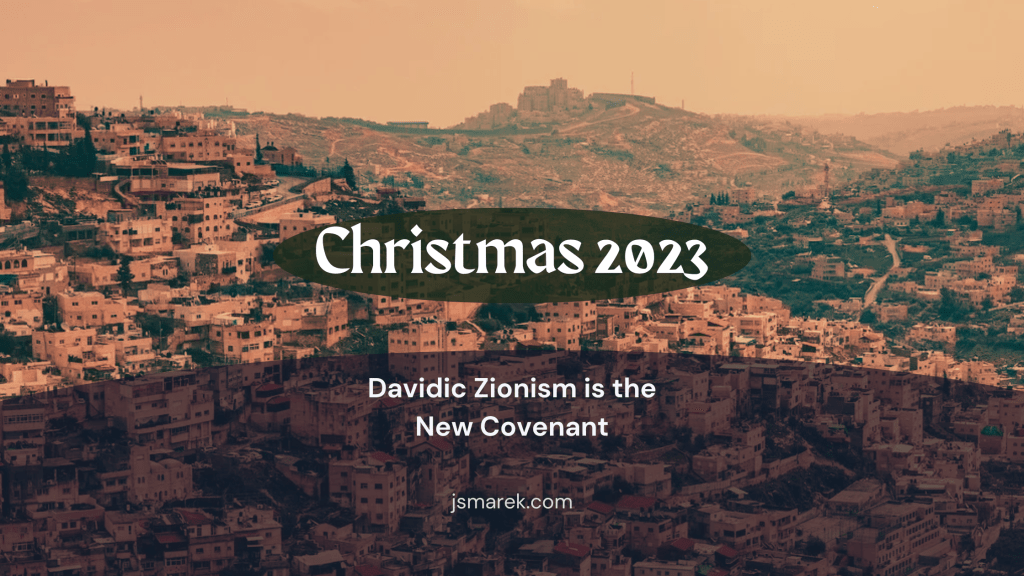
The truth is that the New Covenant is Davidic Zionism. Davidic, in the sense that the kingdom only comes through the promised Son of David, Jesus of Nazareth. Zionist, in the sense that the Jewish people have received a divine and everlasting inheritance in earthly Israel. It is through Davidic Zionism, that is, the government of Jesus on the earth, that the New Covenant promises are fulfilled in Israel and throughout the nations.
If we are to believe Paul’s account in Romans chapter 11, neither our resurrection from the dead, nor our eternal inheritance/salvation as non-Jews, is secured until all Israel is saved and secure. We, “the nations”, are divinely linked to Israel in something Paul refers to as the “mystery of Christ” (Ephesians 3:1-6).
So, I ask you this as you reflect on the birth of a Jewish man born roughly 2,000 years ago, “What role might you have to play in God’s divine plan to restore the earth and the heavens through Israel?”
You have been invited to participate in this great work, to proclaim the Gospel of the King of the Jews to every tribe, nation, and tongue. You have been invited to reach Jesus’ countrymen, Israel, with this very same Gospel, and this same Gospel demands your response to be faithful in the good work of righteousness. Whether it be to the nations, to Israel, or to your own city or family, there is work to do.
As I often remind people at a time of year we’re celebrating the birth of our savior, these are the days to be proclaiming the not only His birth, but also His soon coming kingdom, through which we will finally receive and benefit from the fullness of the New Covenant hope.
Born is the King of Israel!
– J. S. Marek
*This year, I have included our advent themes in a simple 2pg PDF. Download free today. This is a good resource to share with you family at dinnertime to spark discussion and reflection on the biblical promise of Messiah. Have a blessed Christmas, Advent, and Hanukkah!
 J.S. Marek