Challenging the Doctrine of the Church & The Doctrine of the Tithe
What is the church? Should there be a recognized clergy? Is tithing to your church a biblical practice?
Listen to my Introduction to the New Reformation, where I take a stand on the doctrine of the church, its clergy, and the doctrine of the Tithe.
Full Text Version Now Available Below
Hi Friends,
Today’s message has been a long time coming. We will be looking at the need for a new reformation in the body of Christ. I’m kind of throwing my head on the chopping block with this one, as I will be expressing what are probably my most controversial views.
The function of this address is to survey the only the most widely held theological views consistent within the majority of Christian denominations, and bring correction where I believe it is needed. The scope of this address is not to provide an exhaustive list of errors. Today, in fact, we will only look at two issues.
- The Government of the Church
- The Tithe
- Conclusion
- The Government of the Church
Personal Faith Statement:
I am in agreement with the theological view that the body of Christ, typically referred to as the church, consists of the whole number of the elect throughout the ages. We are the body of Christ, the Bride of Christ, and the ambassadors of His Gospel. Together, we are a priesthood of all believers. This body consisted first of all of the Jews who put their hope and faith in the Christ-King, revealed to be Jesus of Nazareth. During the apostolic era, the hope of Christ was extended also to the Gentiles, who according to the apostle Paul, have been made co-heirs with Israel in the promise of Christ.
This same Jesus is the head of the body. He is the Son of God and the Son of man, fully God and fully man. He is the root and offspring of David, of the tribe of Judah. He is the Father’s own, beloved, begotten, unique, and honored Son. This Jesus is the one and only head of the body, and we, the body, are the fullness of Him who fills all things.
I am in disagreement with the common application of the theological view that Jesus has appointed a government of church officers (clergy/bishopric/pastorate), who are distinct from the civil government. The application of this teaching throughout nearly all of Catholic, Orthodox, and Protestant Christianity is a perversion of Jesus’ teaching in Matthew 16. It is a doctrine of demons.
The common application of this theological view since the establishment of the Roman Catholic Church, teaches that the keys of the kingdom are permitted to the church government, by virtue of their office, thus creating a distinct clergy (a separate priesthood) within the body of Christ. This theological view, or some form of it, is found within the creeds, catechisms, confessions, and statements of faith of nearly all formal denominations and church organisations throughout Christendom.
Explanation, in Detail
It was never intended for the global church to have a formalized or institutionalized government of clergy or any kind prior to the return of Jesus. When we consider the apostleship of the Gospel, granted first to the twelve, later to the likes of Paul, Silas, Timothy, and others, their grace and authority was in the proclamation of the gospel of the kingdom. Once a person receives the gospel, they are then committed under the headship of Christ, not the minister.
The apostles were not establishing churches in our modern sense. They were making disciples, who would then go and make more disciples. There were no career clergy members. Career clergy was developed after the apostolic era and was codified in Catholicism and continued through to Protestantism.
The early believers met in homes, synagogues, public places, and even the temple in Jerusalem before its destruction.The closest thing to a formal clerical government among the followers of Jesus was the process of discipleship, and the process of discipleship demanded that all believers be discipled and then become those who make disciples. In other words, the idea of clergy and lay people did not exist. All believers were the clergy, if you will. New Testament Christianity is a priesthood of all believers.
A formalized christian clergy developed later. The earliest formation of a christian clergy developed during the era of Gentile christian separation from our Jewish origin. The elders of the faith, from as early as the close of the first century through the third century and beyond, began to steer the body of Christ away from Judaism and the Jewish people. We often refer to these leaders as the church fathers. These leaders began to place more emphasis on their office of ministry, prioritizing the rule of faith, that is, the authority of the church as administered through its ministerial offices. It was claimed that the authority of these ministerial offices, the clergy, would provide correct biblical interpretation and present it to the layperson. Essentially, you now need to rely on the church’s authority so as to avoid false teaching and heresy.
This separation from Israel and the Jewish people demanded a strong authority and the formation of a new body, or church. If Israel was no longer in the plan of God, there must be a people and/or an institution to replace Israel. Christian clergy became, in essence, an ecclesiastical form of replacement theology, the doctrine which claims that the church has replaced Israel.
Despite the attempts of believers who would push back against this hijacking of the faith, it appears that the trajectory of the body of Christ was tragically set into motion. The church began to develop and codify its own priesthood.
In truth, there was no reason for Christians to have a clergy, because the whole body of Christ is universally both the priesthood and the temple. The presence of a Christian clergy, or priesthood, also undermined the priesthood upheld by the Scriptures. The priesthood that existed was the Levitical Priesthood, which oversaw the Temple in Jerusalem. Since the destruction of the temple in Jerusalem, there is no longer a required priesthood (at least, in the sense of a specific human appointment to a priestly office). When the temple is rebuilt in Jerusalem, there will be a priesthood again.
The global body of Christ (Jew and Gentile alike), is both a spiritual temple and a priesthood. All of us. In other words, there has never been a need for a special class of clergy or priesthood within the spiritual body.
This imagery was already set forth in the Old Testament, and was never reinterpreted by Jesus or the apostles. In Israel, there was a specific priesthood for the temple. Yet, the whole nation of Israel was considered the assembly (ekklesia, community, church). They were all a royal priesthood and a holy nation. Peter reiterates this idea in his first epistle, and so does the book of Revelation. Israel was called into this identity first. Then Gentiles were invited in. Paul teaches us about this in the book of Ephesians by describing the Gentiles as being formerly separate from the Commonwealth of Israel, but are now made co-heirs with Israel in the promise of Christ. In other words, Israel is the pre-existing congregation, and the Gentile was gathered in. Paul calls this the mystery of Christ. It was a mystery, in part, because it was revealed that the Gentile has no need to become Jewish to become part of the community. They get to reap from the commonwealth of promises to the Jewish community and are invited to follow the Jewish Christ without needing to become Jews themselves.
So, concerning the temples, there is the physical temple in Jerusalem which will one day be restored. There is also the spiritual temple, which is the body of believers. The physical temple belongs to Jesus. The spiritual temple/body of Israel belongs to Jesus. He bought them at a price with His precious blood on the cross. Gentiles were brought into this same spiritual temple/body. For this reason, there is no need for Gentile Christians to create a physical temple (or church), and if there is no physical temple/church, there is no need for a separate priesthood (or clergy).
When we consider Paul’s teachings, we need to do so in light of what Jesus stated previously. Concerning the idea of church, we need to go back to Matthew 16. I will summarize it for you.
Jesus brings the disciples to Caesarea Philippi and asks them, “Who do people say the Son of Man is?” After a short back and forth, Peter declares, “You are the Messiah, the Son of the living God.”
It is possible that Peter’s statement is the the first verbal realization and confession that Jesus of Nazareth is both Messiah (the human descendant of David destined to rule over Israel from earthly Jerusalem) and He is also the Son of God (the fully divine, One True God who dwells in perfect unity with the Father and Holy Spirit). This is a remarkable revelation!
Jesus tells Peter that he is blessed because flesh and blood did not reveal this to him. This revelation comes directly from the Father. Jesus goes on to tell Peter that it is upon this rock of revelation that Jesus will build His church, and the gates of Hades will not overcome it.
You might say, “There it is, the church! Jesus just told us that He is starting this new thing called the church.”
There is a problem with this thinking.
First of all, that word doesn’t mean church as we know it. Jesus is talking about something else. We need to consider the words Jesus used, and the context in which He used them.
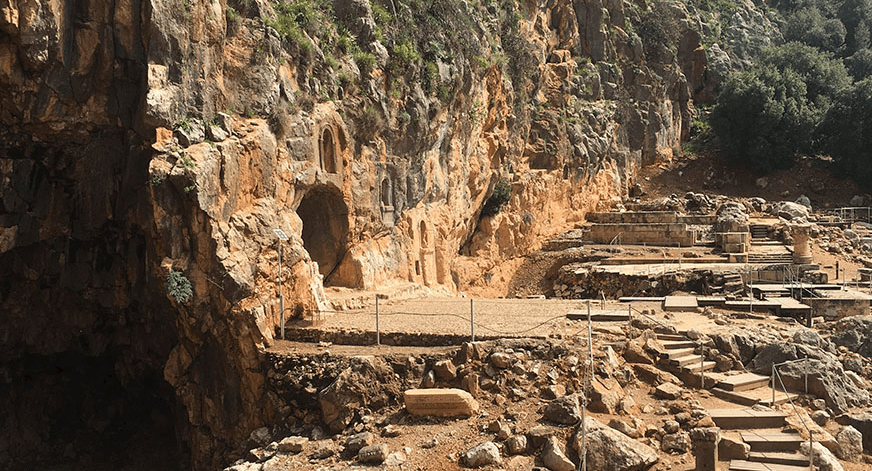
Jesus went out of His way to take the disciples all the way over to Caesarea Philippi. This was a place of Gentiles and pagans. It was at the foot of Mount Hermon, in a place of worship known as the Gates of Hell. Jews considered it a gate to the Gentiles. There was a sanctuary to the Greek god Pan. Herod built a temple for Emperor Augustus here. Of all the places where Jesus could have taken the disciples, this is the most Gentile, pagan, idolatrous place they could have reached on foot.
Standing there, Jesus tells the disciples that upon the revelation of who He is, Jesus is going to build an ekklesia that will invade this hell-hole and come out victorious. So, this begs the question, what is this ekklesia, or church?
To answer this question, we need to understand that this is an apocalyptic statement being made by the Jewish Messiah King. It is first and foremost a statement about the son of David expanding the territory and dominion of the Davidic throne. It has far more in common with Psalm 2 than it has with the Catholic teaching on apostolic succession, the Lutheran doctrine of the keys, or Chapter 30 of the Westminster Confession. Jesus is telling the disciples that He is establishing His government among the Gentiles and will do so by building His ekklesia.
While we are on the subject of language, let’s look at this word ekklesia. This is a Greek word with many meanings and applications. It sometimes referred to those who were summoned, or called out from the Greek community to serve in the assembly of the city states. Sometimes this word refers to a mob. Sometimes, this word simply refers to a gathering or meeting. This was a very well-known and almost antiquated word by the time of Jesus. It certainly wasn’t anything new.
Ekklesia was also the word used in the Septuagint (the Greek version of the Old Testament), to describe the assembly of Israel. [Remember, that assembly I was talking about earlier that began with Israel and then the Gentiles were gathered in]. In reality, while the New Testament was recorded in Greek, Jesus was likely speaking to the disciples in Aramaic. He most likely used the Aramaic word knista, or the Hebrew word qahal. Regardless of the actual word Jesus spoke, the disciples would have understood Jesus to mean The Assembly of Israel.
Jesus is telling the disciples that when He builds His own assembly in Israel, it will rule over the Gentile nations. In other words, Jesus is not starting something new, He is promising that He will govern something that already exists. This pre-existing entity is the assembly, or congregation of Israel, which was called out of Egypt and made a covenant with Yahweh at Mount Sinai.
Claiming that Jesus was starting a new institution when He said, “I will build My…”, would be like saying that everytime a newly elected President is inaugurated, a new United States is formed, one which replaces the previous United States.
Using this logic, we are left with a simple conclusion. The church can’t replace Israel because the church is not an entity created by Jesus. The church is, at its very best, a man-made invention.
Jesus’ following statement in Matthew 16 reinforces the idea. Jesus says, “I will give you the keys of the kingdom of heaven; whatever you bind on earth will be bound in heaven, and whatever you loose on earth will be loosed in heaven.” Binding and loosing is a rabbinical term. It means to forbid or to permit something according to biblical law.
From a church perspective, this is where the “doctrine of the keys” comes from. This is the basis upon which many reformed churches teach that the church (meaning its clergy and institution, not necessarily the priesthood of all believers) has the ability to enforce laws, creeds, and to determine which theological views are considered sacred. This viewpoint only hints at the truth.
When Jesus tells the disciples that they will bind and loose, Jesus is giving them the authority to make determinations based upon the law. We see this take place in Acts 15, when the apostles and elders in Jerusalem advise Gentile believers to follow the laws associated with resident aliens of Israel. Here, we see the Jewish apostles and elders encouraging and comforting their Gentile brethren by removing from them some of the burdens of Jewish law.
This “unburdening” is what biblical leadership should look like, and yet, the church seemed to depart from the model set forth by our Jewish apostles. Instead, we created our own church that was separate from Jewish apostleship, and created a religious monster that had more in common with the worst of Pharisaical teaching. The more the church tried to rid itself of its Jewish origins and leadership, the more we turned out to be like the people Jesus rebuked.
- The Tithe
Personal Faith Statement:
I am in agreement with the command to give generously, to take up free-will offerings, to share with others, and to meet one another’s practical needs. Extravagant generosity and hospitality should be the character of everyone who follows Jesus. This is not always monetary, but can also be the giving of time, resources, talents, and also includes our efforts to protect and defend the needy or downtrodden.
I am in disagreement with the teaching of tithing to the church. When we impose a tithe, we are also reinforcing the importance and sacredness of church buildings, denominations or organizations, and our clergy. Some of the first attempts at instituting a church tithe began as early as the mid third century, almost 200 years after the writing of most of the New Testament.
It would not be until the Council of Tours in 567, and the Council of Macon in 585 that church tithing was an officially recognized doctrine. Church tithing was not part of the New Testament expression of Christianity, and it provides strength to the erroneous institution of the church.
Explanation, in Detail
By instituting the tithe, we are essentially equating our church organizations with the Jewish temple system. In a weird way, the tithe system is also a backdoor form of replacement theology. If we believe that the church is now the true Israel, then the church building is our temple storehouse, or at least, this is how I’ve heard it taught. We now have our Christian version of the temple tax, and while some of those who minister the word of God are most certainly doing a work “worthy of its wages”, the same cannot be said about a church that serves as an illegitimate counterpart to the temple system.
Part of the irony of the tithe issue is that, in the future, there actually will be a rebuilt temple in Jerusalem receiving tithes and offerings. During the second temple period, the Jewish people re-instituted the tithe system according to the Law.
In the book of Malachi, the emphasis of the tithe seems to be placed on Judah and Jerusalem. While there is no directive given to Gentiles, we do see the blessing bestowed on those who bring their tithe into the storehouse of the temple. In my mind, this may encourage us to be willing and joyful participants. Even so, prior to the return of Jesus, there seems to be no directive given to Gentiles regarding tithe. I believe there is liberty here to do as you believe you are being led by the Spirit.
After Jesus’ return to earth, the testimony of the prophets declares that the Gentiles will bring offerings to Jerusalem. We see this mentioned in Zechariah 14. While Zechariah only mentions an abundant offering (no tithe specifically mentioned here), we are provided a glimpse of the nations coming to worship Jesus during the Feast of Tabernacles in earthly Jerusalem during His millennial rule and bringing a wealthy offering to leave at the altar. Still even here there appears to be no specific tithe mentioned.
The church tithe doctrine is a form of spiritual abuse and manipulation designed to strengthen and support a bastard religious system. While I do not believe there is ill intention by many pastors and church leaders today (many of our clergy are simply doing what they’ve been taught), we must remember that teachers will incur stricter judgment. Tithing can have a severe effect, especially on poor families. Teaching the tithe as though it is the command of God for your church members should be a fearful thing. We must remember that we will be held accountable before the judgment seat of God for what we preach to our communities.
Many of our churches preach, “In essentials, unity; in non-essentials, liberty; in all things, charity.” I have heard other pastors claim that they “shout where the bible shouts, and whisper where the bible whispers.” Yet, in many cases, we don’t take our own advice when it comes to tithing.
I actually believe the tithe issue is a relatively small manner for most Christians who long to give a joyful offering, but it is a grave manner for the leaders of our communities who are promoting a doctrine of injustice. In the past, I have encouraged other believers who disagree with me to tithe if their conscience demands them. Going forward, I will no longer continue to do so because the tithe is a tool that props up a system that should not exist.
- Conclusion
As I mentioned in my introduction, the scope of this address is to survey the errors of only the most widely held theological views consistent within the majority of Christian denominations. There are many other issues I could bring up. There are many solutions that I have not begun to discuss.
The first step to reformation is admitting that a reformation needs to take place. I hope I helped you realize this today.
Before I conclude, I do want to make an important statement. While my goal is to contend for drastic changes in the body of Christ, I also want to express my gratitude for my fellow brothers and sisters in Christ. I know many pastors and ministry leaders. Though I differ on some very important teachings, I also want to affirm my brothers and sisters who have labored in devoting their lives to the ministry. I know many of you personally, who did not choose ministry for some kind of profit or status. You did so because you love Jesus and you love people. This cannot be forgotten, especially by someone like myself. I may disagree with the methods, and I may come with a tone of rebuke, but I want to make it very clear that I understand the sacrifice of those who devote their lives to the clergy. I want to change the ecclesiology because it is poison to many who seek to be leaders within the body.
My hope is that we can see a better way. I have seen so much pastor burnout. It is not due to a lack of love for the body of Christ or a lack of love for God. We need new methods that emphasize the priesthood of all believers. It is okay to challenge the calling of the clergy and even the calling of the church. As those who do lead congregations, my hope is that you would be the first to step out and tell others that there is a better way.
There is so much more to address, and I will address it in time. For now, I pray that the LORD bless you with every spiritual blessing for those who are in Christ Jesus.
Amen.
J. S. Marek
 J.S. Marek