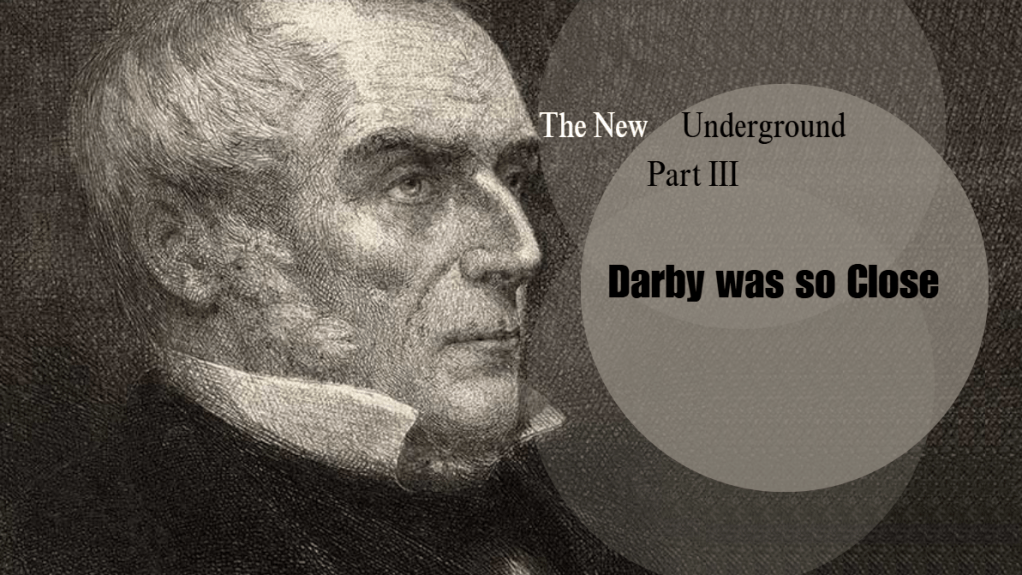
Darby was So Close, But Missed One Vital Truth
Hi Friends,
In today’s article, I will look at the ministry of John Nelson Darby, a man whose teaching provided the foundation of one American Christianity’s most popular theological systems, Dispensationalism.
Restorationism in the 1820’s
The 1820’s was a time in America where restorationist teachers began calling for another reformation of sorts, because they believed the church had fallen away from its original purity and needed to be restored. Similar to the reformers who came before them, such as Luther, Hus, or Calvin, these restorationists claimed that church traditions, moral excess, and bad theology had corrupted the pure and simple devotion of the church to their Lord and Savior, Christ Jesus.
Where other restorationists fell into deep deception and heresy, such as Joseph Smith, the work of John Nelson Darby stood out among the crowd due to his devotion to the Bible. One could argue that Smith, who founded the Mormon church, had a bigger institutional impact. He created one of the largest offshoot cults of western Christianity, now with over 17 million adherents. Unfortunately, the Mormons hold to beliefs so distant from biblical Christianity that they really can’t be called Christian.
Darby, on the other hand, drove others in the restorationist movement back to the Scriptures. Where Smith created his own revelation, Darby faithfully clung to the revelation of the Holy Bible. In contrast to Mormonism, approximately 50-80 million evangelicals worldwide are taught a form of Darby’s dispensationalism every Sunday.
Don’t You Usually Pick on Dispensationalists?
If you have read my articles for any length of time, you know I call out what I believe to be the errors of dispensationalism, especially their views regarding a pretribulation rapture, which anticipates that believers will be taken into heaven prior to a 7 year tribulation period before the return of Jesus.
You might be wondering why I hold Darby in so high esteem.
Simply, Darby was a leading advocate in his time who promoted that Christians should depend on Scripture alone, interpreted in its plain grammatical and historical context. He believed that church hierarchies, traditions, and philosophical systems had become corrupted by tradition and spiritualized interpretations.
These are the same principles I am advocating for today. Darby rejected all formal clergy, hierarchy, and denominational governance, and advocated for no distinction between clergy and laity. He wholly rejected liturgical systems, church membership, and denominationalism. In its place, he encouraged that all believers celebrate the Lord’s Supper with no officiating minister, and that believers gather with the understanding that their unity is rooted in a devotion to a historical grammatical public reading and teaching of Scripture. Their worship was simple and “Sprit-led”, deliberately avoiding denominational liturgies.
You might wonder how this man’s theology had become systemized into a biblical theology now used by many denominations, such as Calvary Chapel, many Southern Baptists, Assemblies of God, and not a few non-denominational evangelical churches who prioritize the very hierarchy, church membership, and governance methods which Darby held in derision.
Here is the short answer: Darby’s emphasis on reading biblical prophecy through a literal lens resonated with many Christians. Darby’s theology, dispensationalism, focuses on a literal restoration of Israel. While Darby’s influence was not particularly tied to early Jewish political Zionism, dispensationalism broke with replacement theology by affirming God’s ongoing plan for Israel’s future restoration. It provided an opportunity for the end-times minded Christian to fall in love with Israel again. Later, Darby’s theology would be systematized in the Scofield Reference Bible, and Dwight L. Moody’s efforts brought the theology into the evangelical limelight. Darby’s teachings (and later adaptations of his teachings) would thrust dispensational eschatology (end-times study) back into the pulpit.
A New Take on an Ancient View of the End-Times
Historic premillennialism is the idea that Jesus returns to the earth prior to the start of a literal Millennial age on the earth, and this 2nd advent of Jesus is what “kicks off” the new age of righteousness. Prior to the return of Jesus is a period of time called “The Great Tribulation”. Dispensational premillennialism, which Darby taught, is a modern take on an ancient doctrine, by adding a rapture event prior to the tribulation period. In essence, dispensationalism teaches that the church is raptured, that is, taken up to heaven, prior to the time of trouble that will face the earth.
This is where the “dispensational” aspect of the doctrine comes into play. In essence, the classical dispensationalism of Darby teaches the age (or dispensation) of the church began at Pentecost in Acts 2. During the church age, Christians are tasked with sharing the gospel of Jesus Christ until the day of the rapture, which signals the end of the church age. They would claim that the Tribulation is Jacob’s trouble, which comes from Jeremiah 30:7.
If you know your Old Testament trivia, you know that Jacob was re-named Israel. This is a very simplified summary for time’s sake, but dispensationalism teaches that Israel is cut off from grace until the end of the church age. Once the church is raptured, Israel will undergo the tribulation, and the survivors will be saved and become part of Jesus’ kingdom when He returns to earth.
In dispensationalism, Israel and the church are two separate bodies. On the positive side, dispensationalism taught a future hope for Israel. On the negative side, I believe their theology lends to a temporary “replacement theology” which says the church age serves as a parenthesis in God’s plan for Israel. To be fair, many dispensationalists would disagree with my assessment of their theology. Yet, my point maintains its logical stance.
Among many evangelicals, especially in the United States, dispensationalism has become the prominent view of the end-times. It effects the way they evangelize, how they view the natural earth, and how they view a Jewish person when they become a follower of Jesus. In many circles, especially Calvary Chapel churches, it can sometimes flow into a dogmatic emphasis on the rapture where some prominent teachers even claim you are “not a Christian” if you don’t believe in a pre-tribulation rapture.
Back to the Point of My Article
I believe Darby started on a great path. The work he did to recalibrate much of western evangelicalism back to the holy Scriptures, to put a simplified grammatical reading of the text into the hands of the average person- must be lauded!
Where I would argue that Darby erred, is in his understanding of the church and Israel. On one hand, we can thank Darby’s theology for bringing Israel back into the forefront of Christian thinking. On the whole, dispensationalism rejects the notion that God replaced Israel with the church. This is a great thing! All Darby had to do was show people that Israel IS NOT a metaphor for the church, but rather a distinct people who made an everlasting covenant with God.
To give credit where credit is due, I actually believe that without dispensationalism many in the U.S. would not have such a high view of Israel. We can thank dispensationalists, at least in part, for the fact that much of America is friends with Israel and the Jew.
For this reason, I am thankful for the many dispensational churches out there!
However, my appeal is simply to think outside of the box in which dispensationalism places the scriptures. Here’s what I mean: You have a wonderful history of reading the plain meaning of the text, trusting that it is the word of God, and applying it to your lives and the world around you. I commend that, heartily! Even so, my encouragement is to read the text without the lens of the “church age”. Where does the bible actually teach that the “church” began in Acts 2? Where does the text say that?
Consider the New Covenant. Consider the most plain reading of the New Covenant promise. Who was it written to? By whom was it written?
If you’ve been trained in dispensationalism at all, you know that the New Covenant was made specifically with Israel and Judah (based on Jeremiah 31:31-34). Classical dispensationalism teaches that the church benefits from or participates in the New Covenant, but it’s not the primary recipient. (I agree with you that ethnic Israel is the primary recipient.) Yet, you teach separate New Covenants for the church and Israel. On what basis?
You can’t site Jeremiah 31, as a historical-grammatical reading doesn’t allow for separate covenants. You can’t use Luke 22:20, because Jesus was speaking to 12 Jewish apostles, using Jewish covenantal Passover symbolism, when He said, “This cup is the new covenant in my blood”. You can’t use 2 Corinthians 3:6 to refer to a church-specific covenant, because that language cannot be found within the context of the passage.
Using a true historical-grammatical hermeneutic, you cannot reach a 2 covenant conclusion.
You might say, “I’m a progressive dispensationalist. We believe in a shared covenant rather than insisting on 2 separate covenants.” If that’s the case, then go the whole way with it.
The church and Israel cannot be two separate people. Paul teaches in both Romans and Ephesians that the Gentile follower of Jesus is “grafted into” Israel, or “joined together” with Israel in the promise of Christ Jesus.
There is one program going on here. Not two. So, where did the program begin? When did the band first get together? The only reasonable answer is the Exodus. You could argue that the “assembly of Israel” first joined together on the eve of the first Passover. I know some who would make this claim. Yet, it was at Sinai when the assembly of Israel first entered into covenant with God. This is where the covenant of the assembly (see: Qahal [Hebrew], Ekklesia [Greek], Ecclesia [Latin], Knista [Aramaic], Church [English]) began.
The covenant began with ethnic Israel, at Mount Sinai. This is the church that the Gentiles was grafted into. There was and will always be one plan.
Today, many Christians argue about what happens to a Jew when they receive Jesus. Are they a Messianic Jew? Is that somehow different from a Gentile Christian? Do they have to turn away from their Jewish heritage and become “Christian”? Of course, most dispensationalists are just happy they’ve received Jesus and probably don’t care. I’m happy about that, by the way.
The funny thing is though, that this is the exact opposite of what the early believers dealt with. The question of the New Testament was, “how can a Gentile be saved?” The apostles needed to gather all of the “church” leaders to Jerusalem to decide what to do with the Gentiles? Do we make them convert to Judaism?
Seriously, this is a more logical question than we realize? Some in the “church” argued for full conversion to Judaism, circumcision and all. They were already making the Gentiles undergo a ritual washing, a mikvah we call baptism. Yet, it would be the apostles who would say otherwise. It was determined that Gentiles could keep their ethnic identities, not have to convert to Judaism, and still follow Jesus and become partakers of the covenant of the Jewish Messiah.
Paul explicitly states that the dividing wall between Jew and Gentile was torn down by the blood of Jesus, making the two parties into one body. (Ephesians 2:11-16)
So, let me take this an interesting angle. This would mean that both Israel and the Gentile believers (you might say, “church”) are both the bride of Christ. If this is the case, shouldn’t we share together in the wedding supper of the Lamb? When do you say the wedding supper of the Lamb takes place?
The bride of Christ is not complete until the fullness of the Gentiles comes in, AND, all Israel is saved. Both conditions must be met. A pre-tribulation rapture, the separation of the church and Israel are untenable using a historical-grammatical hermenuetic.
The true church is the body that began at Sinai (Israel). Gentiles were grafted into an existing program. There cannot be a Church and Israel, because the “church” as we modern Christians understand it to be is not actually a thing in the bible. There is no “CHURCH” as you’ve always believed, because the church is ethnic Israel. Yes, those Jews can only enter into the New Covenant promises when the receive Jesus as their Messiah. However, you yourselves rightly claim that even at the very end, their tribes will “look upon the one whom they have pierced”.
What you need to understand is that you’ve been called by God as salt and light to lead them through the tribulation and provoke them into a jealous pursuit of knowing Jesus.
The greatest irony of all of this to me is that Darby helped bring us back to the model of “church” that could help the Jew and Gentile actually achieve unity as a body in the midst of the tribulation. It was the mode of church that survived the earliest persecutions described in the New Testament, and is the mode of church that will survive the tribulation in expectant faith. It amazes me that later dispensationalists would spit out the meat of Darby’s ecclesiology and swallow the bones of his dispensationalism.
The vital truth that Darby missed was that Israel and the church are not part of separate, distinct plans.
All I am Asking…
I want you to re-apply your brilliantly simple approach to the biblical text, to draw out its most plain meaning, and to do so without presupposing the dispensational lens. That is all. Come back to the wilderness of biblical fidelity, free from the constraints of a theological system that demands you make certain conclusions.
Please do so, and let me know what you discover.
J. S. Marek
For complete notes of my upcoming bible study, Sinaitic Ingathering Ecclesiology, visit: https://jsmarek.com/2025/07/24/rediscovering-the-true-identity-of-jesus-ekklesia/
Sources Cited
- Lee, Peter David. The Shaping of John Nelson Darby’s Eschatology. University of Wales, 2010. Detailed scholarly dissertation discussing Darby’s dispensational system and its origins, significance, and development.
Link to PDF - CPRC article on Darby and Dispensationalism: Discusses Darby as the key figure constructing dispensationalism, emphasizing the sharp division between Israel and the church as central to his theology.
Link - Liberty University digital archive article A Short History of Dispensationalism: Reviews Darby’s influence as father of modern dispensationalism, his views on the church’s ruin, and the theological distinctiveness of Israel and the church.
Link - Journal of the Evangelical Theological Society (JETS) article on Irish origins of Dispensationalism, giving historical context to Darby’s theological environment.
PDF Link - Oxford Academic chapter J.N. Darby and the Roots of Dispensationalism, offering a comprehensive biography and analysis.
Link - Albert Mohler’s commentary on Darby’s legacy and dispensationalism: modern perspectives on Darby’s role and influence.
Link - Article titled Did Darby Invent Dispensationalism? explores the view that Darby systematized but did not originate dispensational ideas.
Link - The Gospel Coalition review of J. N. Darby and the Roots of Dispensationalism book, summarizing Darby’s intellectual biography.
Link - Acton Institute article How Dispensationalism Got Left Behind traces Darby’s importance and legacy within evangelical and dispensational traditions.
Link
Scripture Cited
- Jeremiah 30:7 — “Alas! For that day is great, so that none is like it; And it is the time of Jacob’s trouble, but he shall be saved out of it.”
- Jeremiah 31:31–34 — The promise of the New Covenant “with the house of Israel and the house of Judah.”
- Luke 22:20 — “This cup is the new covenant in My blood, which is shed for you.”
- 2 Corinthians 3:6 — Reference to ministers of the new covenant.
- Romans 11:17–24 — Gentiles grafted into Israel.
- Romans 11:25–27 — The fullness of Gentiles and salvation of all Israel.
- Ephesians 2:11–16 — Christ breaking down the dividing wall between Jew and Gentile.
- Exodus 12–14 — The first Passover and Exodus.
- Exodus 19–24 — The covenant at Mount Sinai establishing the assembly (qahal) of Israel.
- Revelation 19:7–9 — The wedding supper of the Lamb.
- Zechariah 12:10 — Israel looking on “the one whom they have pierced.”
- Acts 2 — Outpouring of the Holy Spirit at Pentecost.
- Acts 15:1–29 — The Jerusalem Council deciding on Gentile inclusion without full conversion to Judaism.
Biblical Language Explained
- Qahal (קָהַל) in Hebrew primarily means an assembly or congregation, often a gathering of the people of Israel for worship or covenant purpose (e.g., Deuteronomy 9:10). It emphasizes a called together community with religious function and covenant identity. It is never in the Old Testament used in a purely secular or generic sense but connected to the people of God as a collective assembly.
- Ekklesia (ἐκκλησία) in Greek literally means “called out” or “called forth” assembly, derived from the verb ek-kaleo (to call out). In classical Greek it referred to an assembly of citizens called together for political purposes, but in the New Testament it is used for the community of Christian believers, emphasizing their being called out from the world into God’s fellowship. The Septuagint (the Greek OT translation) uses ekklesia to translate Hebrew qahal, thereby linking the terms theologically.
- Ecclesia is the Latin transliteration of the Greek ekklesia, used in the Latin-speaking early church. It retains the same meaning as an assembly or congregation gathered for worship.
- Knista is the Aramaic equivalent of ekklesia/qahal and conveys the same idea of assembly or congregation. It was used among the Jewish-Christian communities who spoke Aramaic or Syriac[exact source for Knista is not common but generally noted in linguistic/theological studies].
- Church in English evolved from the Old English cirice or circe, which itself traces back to the Greek kyriakon (meaning “the Lord’s [house]”). It generally refers to the Christian community or the place of worship. While “church” as a building is common today, originally it meant the collective assembly of believers.
 J.S. Marek
One response to “The New Underground Part 4”
[…] The New Underground Part 4, Darby Was So Close. Focuses on Restorationism, clergy, and biblical […]