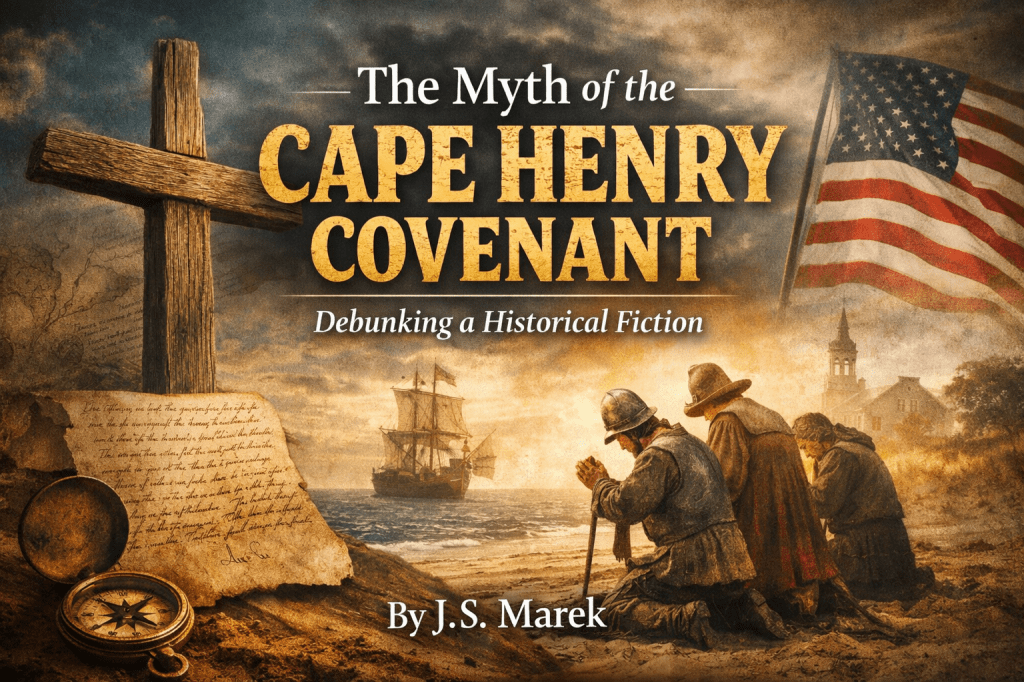
Why This Popular ‘Founding Prayer’ Is Neither Historical Nor Biblical
Hi Friends,
I’ve resisted writing this for a long time. As someone who sincerely believes in the power of Christian revival, my desire is for believers throughout my country to return to wholehearted devotion to Jesus. I long for sinners like me to find the miraculous grace of our Lord Jesus, to turn from their sins, and be transformed into the likeness of His image.
My article today risks making me appear to some as an enemy to this cause. Yet, I write as a fellow revivalist. I believe in the power of the Holy Spirit to bring genuine awakening. I’ve participated in prayer movements and long for God to move powerfully in our nation. But precisely because I care about real revival, I cannot stay silent when I see us building on false foundations. If we want the Spirit’s power, we must commit to truth—even when that truth is uncomfortable.
There are stories Christians want to be true, and then there are stories that are true. The prayer commonly attributed to Rev. Robert Hunt at Cape Henry in 1607 belongs firmly in the first category.
“We do hereby dedicate this Land, and ourselves, to reach the People within these shores with the Gospel of Jesus Christ, and to raise up Godly generations after us, and with these generations take the Kingdom of God to all the earth. May this Covenant of Dedication remain to all generations, as long as this earth remains and may this land, along with England, be evangelists to the world. May all who see this cross remember what we have done here, and may those who come here to inhabit join us in this Covenant and this most noble work, that the Holy Scriptures may be fulfilled. From these very shores the gospel shall go forth, not only to this new world, but the entire world.” – Attributed to Rev. Robert Hunt
This prayer has been used in numerous reenactment events, revival gatherings, commemoration events, and is included in the introduction of Prayers and Proclamations Throughout American History, which was released by the White House.
https://www.whitehouse.gov/america250/america-prays/
We want a sacred founding moment, a spiritual covenant that binds this nation to God. I understand that impulse. But desire does not make history true, and conflating modern theology with 17th-century Anglican practice does Christians no service.
This letter isn’t a gentle correction; it’s a full stop. The prayer widely attributed to Rev. Robert Hunt — the one that dedicates American land to God, binds future generations, and declares America’s global evangelistic destiny — is not a historically defensible document, is profoundly anachronistic, and serves theological agendas that have little to do with historic Christianity. Worse, its popularity today owes far more to Mormon covenant theology and modern evangelical dominionism than to Anglican prayer in the early 1600s.
1. There Is No Historical Basis for the Prayer
Let’s begin with the most important fact: there is no reliable historical source that contains this prayer.
Robert Hunt was the Anglican chaplain of the settlers who landed at Cape Henry in April 1607 and later helped found Jamestown. The National Park Service — which curates the best scholarship on early Virginia — notes that Hunt led the first thanksgiving and prayer services upon erecting a cross at Cape Henry, but no writings of his survive and no contemporary record contains a text even resembling the modern prayer attributed to him. In fact, Hunt left no known writings at all.
The only detailed descriptions of his ministry come from later chroniclers referencing his character, scores of services, and the fact that he presided at worship and Communion before his death in 1608. None preserve the alleged covenant prayer.
The versions of the prayer that circulate today appear only in late 20th- and 21st-century commemorations and devotional retellings — not in 17th-century sources. Among these are programs from Christian organizations that recreate the “First Landing,” often reading the long prayer as though it were historically recorded.
That pattern — a text appearing first in modern devotional rhetoric and not in the period it supposedly originated — is exactly how myths become accepted as history. Absent an original manuscript or independent archival reference before 2000, historians cannot treat this prayer as a verified primary source.
2. The Prayer Is Deeply Anachronistic
Even if someone one day uncovered a previously unknown 1607 manuscript — and I’m not claiming such a discovery has been made — the prayer as commonly presented is still anachronistic in form, theology, and purpose.
a. It Doesn’t Sound or Think Like 17th-Century Anglican Prayer
Anglican liturgy in Hunt’s day was governed by the Book of Common Prayer, first widely issued in English in 1549 and regularly revised in the 16th and 17th centuries.
That prayer book shaped the theology and devotional life of clergy like Hunt. Its prayers are:
- confessional and penitential, not declarative of future national destiny
- Christ-centered, not geographic or teleological
- liturgical and covenantal in the biblical sense, not programmatic mission statements about nations
A 1607 Anglican prayer — from Cranmer’s tradition — would likely have sounded nothing like the modern “covenant” prayer that reads like a mission statement written centuries later by minds steeped in revivalist Protestant theology.
As someone who has participated in many revival meetings, I am deeply familiar with the theology of the movement. When I first heard the prayer I questioned the historicity, however the language was so familiar I didn’t question it. Only when I contrasted the prayer against the language of 17th century Anglicanism did I first realize the dramatic anachronisms.
b. It Twists Concepts found in 17th Century Anglican Theology
The prayer projects:
- that colonial geography could have its own distinct covenant with God, separate from yet equal to England’s national covenant
- that descendants and future generations are bound by a founding declaration,
- and that a colony and England together share a prophetic role to evangelize the world.
None of these projections are taught or implied in the 16th-17th century Anglican tradition. While later Protestant groups such as New England Puritans did adopt forms of social covenant language in the 1620s and beyond, those documents were usually corporate commitments by church members in a local congregation, not declarations imagined to bind nations and generations worldwide.
Moreover, Anglican piety emphasized the Church as the covenant community. As a minister of the Anglican Church, Hunt would have viewed himself first and foremost as shepherding an English congregation that was both a spiritual community and a civilizational outpost. The connections to an “American Covenant” are simply not present.
The anachronism is not in covenant theology itself, but in projecting it onto American lands as a distinct entity with its own prophetic destiny—a concept impossible in 1607, when “America” existed only as a vague geographic notion.
3. Structural Parallels to LDS Theology and Evangelical Dominionism
So where did this prayer come from, if not 1607 Anglicanism?
The content and structure of the prayer — treating land as sacredly dedicated and future generations as covenantally bound — closely resembles—and likely derives from—Latter-day Saint theology, which teaches a fundamentally different gospel than biblical Christianity. If, as I suggest, the prayer originated in the 20th century, these ideas may reflect broader ideological currents aligned with LDS thinking. Some modern dominionist rhetoric also echoes notions of other nationalistic frameworks, emphasizing America’s spiritual role and destiny. Regardless, the Cape Henry prayer is entirely inconsistent with Hunt’s Anglican context and the theology of 1607.
The Book of Mormon and LDS teaching present:
- America as a covenant nation,
- with these divine covenants tied specifically to American territory,
- including covenantal language treating American territory as having its own promised land status distinct from but parallel to Israel.
That framework — territorial covenant, national destiny, and generational consequence — is not part of historic Christian covenant theology familiar to Robert Hunt. The similarity to LDS and dominionist rhetoric is unmistakable.
The prayer has found particularly strong advocacy from those who blend LDS territorial theology with evangelical dominionism. In April 2023, Glenn Beck served as keynote speaker for a ‘Declaration of Covenant’ event in Virginia Beach organized by the First Landing 1607 Project—an event explicitly designed to re-dedicate America based on this alleged 1607 covenant. Such events bring together LDS figures and evangelical leaders around shared covenant renewal rhetoric, despite their significant theological differences.
Modern evangelical dominionism mirrors the LDS structure while replacing Book of Mormon language with terminology drawn from a theologically Reformed vocabulary. This theological blending looks far more like shared covenant architecture than continuity with historic Anglican or Reformation covenant theology. Additionally, for those who embrace biblical Zionism, the theology of this prayer may appear like yet another attempt at supersession from covenantal Israel.
4. Modern Invocation Is Not Revival — It’s Syncretism
To understand how the prayer functions today, look at how it’s used, not just how it’s quoted.
Glenn Beck and “Covenant Renewal”
Beck has repeatedly framed America as a nation under covenant, encouraging listeners to recommit personally and corporately to that supposed covenant. His resources invite people to:
“commit themselves, their families, and their nation to God, asking forgiveness for national sins.”
Historic Christian revival calls individuals and congregations to repentance in Christ. While it sounds great in theory, Beck’s national covenant narrative presumes America’s spiritual role before it presumes individual transformation. If Beck were a Christian, I’d gladly give him a pass, because he would simply be calling our nation back to the Jesus of the Bible. The problem is that Beck is not a Christian. He is therefore calling our nation back to the Jesus of the LDS church, and to the American covenant that exists within LDS theology.
Dutch Sheets and Prayer Movements
Sheets, a key figure in contemporary prayer movements, often promotes this prayer on his “Give Him 15” program, as a tool to activate destiny and enforce covenantal claims over territory and history.
In his Retracing America’s Covenant Roots tour, Sheets’ team visited historical sites including Cape Henry, Philadelphia, Plymouth, Boston, and Washington, D.C., with the explicit purpose of “retracing the covenant our forefathers made with God in the founding of America.” They took communion, poured salt and oil as symbols of covenant and mercy, and “decreed God’s divine purposes for America.”
At Cape Henry, his team renewed what they describe as the commitment of Rev. Robert Hunt — using modern covenant language.
Sheets is explicitly engaging in a ritualized “covenant renewal” tied to American land and history.
American Prays Initiatives
Initiatives like American Prays wrap all of this in patriotic liturgy: invoking American identity, rededicating land, and appealing to national covenant renewal.
None of these movements ground their claims in biblical ecclesiology. Instead, they lean heavily on an invented foundational text and borrowed theology that unites evangelical zeal, Mormon covenant logic, and nationalist sentiment.
5. Why This Matters
This is not just an academic quarrel over old words. The stakes are pastoral and theological.
When Christians adopt a myth as history and then build national destiny theology upon it, we:
- mislocate our identity to prefer national identity over global Christian community,
- eclipse the gospel with civil religion,
- and import frameworks from non-Christian systems into our worship and prayer.
This prayer reflects a pattern that has appeared throughout church history: gentile nations falsely claiming the kind of territorial covenant relationship that Scripture assigns uniquely to Israel. Whether medieval Christendom or modern American exceptionalism, this error has repeatedly misdirected the body of Christ by confusing our identity in Christ with national covenant claims.
American covenant theology cannot be our foundation for revival because it wrongly appropriates Israel’s unique status. The New Covenant in Christ creates one multinational body without transferring territorial covenant promises from Israel to other lands or peoples. We are called to be the multi-ethnic global body of Christ consisting of Jew and Gentile, not to replace Israel or claim for ourselves the everlasting promises given uniquely to her.
This prayer may sound appealing and resonate with our desire for spiritual awakening. But we cannot build genuine revival on false foundations—on invented history, Mormon territorial theology, or the usurpation of Israel’s covenant. Those of us who long for true, Spirit-led revival must build on truth, recognizing that God’s purposes for nations, including America, operate through the body of Christ’s mission to all peoples, not through territorial covenants that belong to Israel alone.
J. S. Marek
Sources
- National Park Service on Robert Hunt’s ministry and the lack of primary writings: https://www.nps.gov/jame/learn/historyculture/the-reverend-robert-hunt-the-first-chaplain-at-jamestown.htm
- Modern commemorations of the “First Landing” and the prayer text’s appearance in recent sources: https://vachristian.org/recap-of-america-rededicated-to-god-at-1607-first-landing-anniversary/
- History of the Book of Common Prayer and Anglican liturgy shaping theology: https://en.wikipedia.org/wiki/Book_of_Common_Prayer
- Puritan covenant examples in early colonial America (for contrast to Anglican context): https://www.apuritansmind.com/creeds-and-confessions/covenants-of-new-england/
- Critiques of David Barton’s historical methodology and credibility issues: https://www.thegospelcoalition.org/blogs/evangelical-history/christian-history-why-david-barton-is-doing-it-wrong/
http://splcenter.org/resources/extremist-files/david-barton/ - Glenn Beck’s covenant rhetoric and modern national covenant framing: http://theblaze.com/shows/the-glenn-beck-program/glenn-says-this-subject-has-been-haunting-him-for-years
- Dutch Sheet’s Retracing America’s Covenant Roots tour:
https://dutchsheets.org/retracing-americas-covenant-roots - What is British Israelism:
https://jewishencyclopedia.com/articles/1524-anglo-israelism
 J.S. Marek