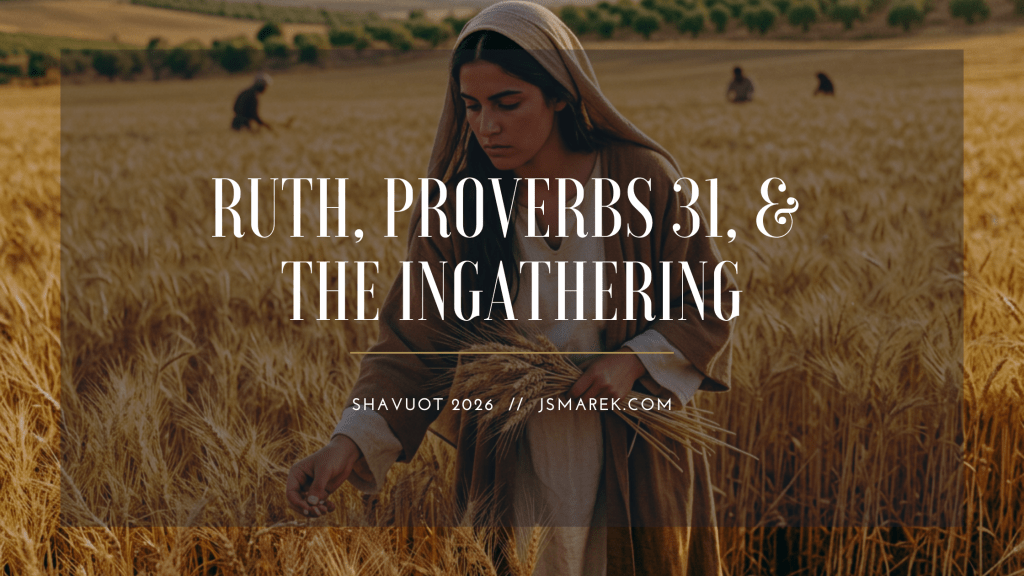
Shavuot 2026
Shavuot & Pentecost
This year, Shavuot begins at sundown on May 21st (6th of Sivan) and ends at sundown on May 23rd (8th of Sivan). Pentecost, generally associated with the Christian celebration, takes place on May 24th this year. Pentecost comes fifty days after Easter, whereas Shavuot is fifty days after the second night of Passover.
For those who may be unaware, Pentecost (Greek: pentēkostē) and Shavuot (Hebrew: שָׁבוּעוֹת) are the Hebrew and Greek names for the same holy day. While these Greek and Hebrew words depict the same biblical holiday, the way Jews and Christians often celebrate is different.
The Jewish people, and occasionally non-Jews, celebrate Shavuot, often referring to it by its Hebrew name. It is one of the biblical feasts and great convocations (sacred dress-rehearsals) of Adoni. Shavuot commemorates the giving of Torah at Mount Sinai. Some of the traditional practices that take place during this feast are the reading of the ten commandments, staying up late to study Torah, reading the book of Ruth, eating dairy and dishes made with rosewater. Shavuot is a time to remember the day when God declared His covenant vows, the Torah, to Israel.
The Christian celebration of Pentecost commemorates the first Shavuot after Jesus’ death and resurrection, when the Holy Spirit fell upon the congregation of Jesus’ disciples and the apostle Peter preached the gospel publicly for the first time. We read about this in Acts 2, where thousands of Jews, Jewish converts, and God-fearers gathered to celebrate Shavuot in Jerusalem. It was here that the crowds heard the testimony of Jesus from the mouth of Peter. More than 3,000 individuals were cut to the heart by Peter’s preaching, making the decision to repent and become followers of Jesus.
In some ways, Shavuot is like a dress-rehearsal of vows or a vow renewal ceremony. For the Jews, Shavuot commemorates a time when the Israelites stood beneath the huppah (wedding canopy) of Mount Sinai to receive God’s vows, the Torah. This is why the ten commandments are read during Shavuot and why the Jewish people stay up late during Shavuot to study the Law.
For the Christian, Pentecost commemorates the giving of the Holy Spirit to Jesus’ followers. Jesus promised the gift of the Holy Spirit, of whom Paul refers to as the pledge (promised guarantee) that we belong to Christ and will share in His inheritance in the age to come. This too is a vow from God. By receiving the pledge of the Holy Spirit and the salvation of Jesus, we have been joined into the covenant promises of God and made co-heirs with Israel in the promise of Jesus Christ.
In fullness, Shavuot commemorates the events of the giving of Torah at Mount Sinai, and also the New Covenant promise of Torah being written on the heart and mind. The Old Testament expression of this holiday commemorates the creation of God’s body, Israel. The New Testament expression of this holiday commemorates the nations being gathered into this body through the testimony of Jesus and the pledge of the Holy Spirit. It is the vow of the Law through which we learn of God’s faithful decree to establish an assembly (congregation / community / fellowship) of His own. For us who are non-Jewish, that is, Gentile followers of Jesus, we would be well served to heed this annual reminder of the Jewish foundation upon which Christianity exists. We need to remember that it was the Jewish congregation (Greek: ekklēsia; Hebrew: קהל “Qahal”) which predates the church (Greek: ekklēsia). As the martyr Stephen confessed in Acts 7, the early disciples of Jesus still believed in the irrevocable calling upon the church of the wilderness during the time of Moses and Israel’s exodus out of Egypt.
The Gentile Christian needs to understand that we were grafted into one body with Israel when we became followers of Jesus, just as the Jewish person needs to understand that Jesus of Nazareth is the promised Messiah of Israel. For all people, there is no name other than Jesus by which mankind can be saved. Similarly, there is no ekklesia other than the congregation of Israel which mankind can be saved into. The King of Kings and Lord of Lords is also the God of Israel. When the apostle Paul states, “He is the head of the body, the church”, we must understand that this ekklesia (church) which Paul speaks of here is the same body of people which Paul refers to as the “Commonwealth of Israel” in Ephesians 2. The mystery of Christ Jesus is that both Jew and Gentile are members together of one body.
“There is one body and one Spirit, just as you were called to one hope when you were called; one Lord, one faith, one baptism; one God and Father of all, who is over all and through all and in all.”
– Ephesians 4:4-6 NIV (see also: Colossians 1:18; Ephesians 2:11-3:6)
Before continuing, I will address the elephant in the room. Whenever we talk about the Jewish foundations of Christianity, there is always the concern that the one speaking of such things is trying to Judaize the church. First of all, I am not Jewish and don’t actually know a lot about Jewish practices, so I doubt that I’m actually capable of Judaizing anything. Additionally, we need to realize that throughout the Old and New Testaments there are many examples of non-Jews becoming part of the commonwealth without becoming Jews. In the Old Testament, they were referred to as the “foreigners living among you”, and in the New Testament, they were referred to as “God fearers”. While many previously believed that these foreigners could not actually become part of the congregation, it would later be revealed through the mystery of Christ that the foreigner Gentile could in fact be joined into one body (congregation) with Israel without having to become Jewish. I guess you could say this is part of the reason why Paul refers to it as a mystery.
The question of whether or not Gentiles needed to convert to Judaism was forever answered by the apostles and explained in great detail by Paul. Let me make this very clear: God loves the nations and desires to gather us in and make us co-heirs with Israel in the promise of Christ. We are welcomed into the community, have been given the Holy Spirit, have received both the Great Commission and the promised everlasting life in the age to come. At no point does one need to convert to Judaism to receive these promises. While there are both biblical and historical examples of Gentiles converting to Judaism, this is not a requirement demanded within the body of Christ, and it was discouraged by Paul when he ministered to the Gentiles.
As Paul wrote,
“Nevertheless, each person should live as a believer in whatever situation the Lord has assigned to them, just as God has called them. This is the rule I lay down in all the churches. Was a man already circumcised when he was called? He should not become uncircumcised. Was a man uncircumcised when he was called? He should not be circumcised. Circumcision is nothing and uncircumcision is nothing. Keeping God’s commands is what counts. Each person should remain in the situation they were in when God called them.”
– 1 Corinthians 7:17-20 NIV
Understanding these foundational truths will help us to better uncover the wonder of the story of Ruth, which is an Old Testament precursor to the mystery that would be revealed later and more fully through the ministry of Jesus. Ruth’s story shows us how a Gentile woman was redeemed by an Israelite kinsman-redeemer, brought into God’s family, and eventually became the great grandmother of King David. Our redeemer, Jesus of Nazareth, is destined to sit eternally on David’s throne as Israel’s king.
In this year’s focus, I want to look into Ruth’s connections to Shavuot, and how we can apply these connections to the identity and purpose of the body of Christ. We will look at Ruth’s story, her connection to Proverbs 31, and how it can inform our identity and calling as the body of Christ.
Ruth’s Connection to Shavuot
The Lord said to Moses, “Speak to the Israelites and say to them: ‘These are my appointed festivals, the appointed festivals of the Lord, which you are to proclaim as sacred assemblies…
Count off fifty days up to the day after the seventh Sabbath, and then present an offering of new grain to the Lord…
On that same day you are to proclaim a sacred assembly and do no regular work. This is to be a lasting ordinance for the generations to come, wherever you live.
“‘When you reap the harvest of your land, do not reap to the very edges of your field or gather the gleanings of your harvest. Leave them for the poor and for the foreigner residing among you. I am the Lord your God.’”
Leviticus 23 (Selections from verses 1-22) NIV
I absolutely love how God plays the long game, and does so in such a way as to continuously reward those who honor Him. Shavuot takes place during the time of the barley harvest in Israel. Part of God’s command in context to this feast required field owners to leave the edges and gleanings of their field as food for the poor and foreigners living among the Israelites.
It reveals God’s heart for justice and equity, to lift up the downtrodden, the poor, and the wanderer. I imagine what was likely millions of people over the course of centuries who benefited from the obedience of those who chose to honor God with their abundance.
The Law in Leviticus was given approximately 360 years (a personal estimate) before the life of Ruth. She arrived in Bethlehem with Naomi during the barley harvest, presumably near or during the time of Shavuot. She would benefit greatly from Boaz being the type of man to honor God’s commands and allow the gleaning of his field. This is remarkable, because Boaz lived during the time of the Judges, when it was said of Israel that they,
“knew neither the Lord nor what he had done for Israel.”
– Judges 2:10 NIV
While many of his brethren did not know or follow the ways of God, here stands Boaz as part of the faithful remnant of Israel that has existed in every generation. He was a man from the tribe of Judah, who honored the Lord and obeyed the Law which was given to Israel.
Still, Ruth’s connection to Shavuot and the giving of the Law would not stop there.
The Law of gleaning during Shavuot would allow an opportunity for a Gentile, a Moabite woman named Ruth, to join the family of God and even become the great grandmother of King David. However, it would be a different law concerning the Moabites (see: Deuteronomy 23) that would put the whole situation into jeopardy.
Under normal circumstances, it would seem a Moabite such as Ruth would not be permitted to join the congregation of Israel, and her descendants would have been considered illegitimate up to the 10th generation. If Ruth would have received this judgment according to the law, it would mean that David himself ruled illegitimately as King in Israel. If David were illegitimate, the entire Davidic Covenant and promise of Messiah would be illegitimate.
Today, we might not think this is a big deal. As modern Christians, we don’t think about the law as much and certainly do not think about it in the same way or on the same terms as an ancient Israelite. But we need to understand that Christ came to fulfill the law, not abolish it (see: Matthew 5:17-20). If the Davidic Covenant (by nature this includes the promise of Messiah) were illegitimate according to the Law, then it would be impossible for Jesus to fulfill God’s Law. Jesus Himself tells us that fulfilling the Law is part of His mission.
So there must be another explanation.
Possibility # 1
Using a grammatical approach, the simplest reason for legitimacy is because Ruth is a woman. In Deuteronomy, Moabite was written in the masculine form, which led some to believe that Moabite men were excluded, but women may have the opportunity to be included. This feels “loop-holey” to me as a modern reader, but I am also not an expert on biblical Law.
Personally, I doubt this was the logic used by Boaz, but this is a strong grammatical argument used later by Rabinnic scholars to legitimize the authority of David. When I read the book of Ruth, Boaz appears to have considered his status as Ruth’s kinsman redeemer to be the legal precedent for him to marry Ruth. Yet, for those who would examine the Mosaic Law to determine whether or not Jesus could be the Christ, this grammatical argument is important.
Possibility # 2
David was only the third generation from Ruth, however Jesus was well beyond ten generations from Ruth and would have been considered fully Jewish so long as He was raised Jewish and had Jewish parents. This legitimizes Jesus’ status, but not David’s. Yet, it was David himself who saw a greater and perfect Messiah who would claim the throne. David knew he was imperfect and unable to fulfill the whole requirement of God. Knowing this, David put his faith in God and expected the promise of the future Messiah King who would come from among his descendants.
Possibility # 3
Ruth had shown herself to be a “worthy woman” (Ruth 3:11). Here the term worthy (Hebrew: חַיִל “chayil”) refers to someone who is strong and full of virtue, capability, and valor. We will look at the connections to Proverbs 31 later, but for our purposes here we know that Ruth had already declared to Naomi…
“Don’t urge me to leave you or to turn back from you. Where you go I will go, and where you stay I will stay. Your people will be my people and your God my God. Where you die I will die, and there I will be buried. May the Lord deal with me, be it ever so severely, if even death separates you and me.”
– Ruth 1:16-17 NIV
Ruth made a complete heart conversion to follow the God of Israel, and she showed herself to be worthy of this conversion. She endured the potential shame of her status in the community, and was eventually elevated to a status of inclusion. She may not have been considered a Hebrew in the literal sense, but she reaped the full benefit of those who put their faith in the God of Israel. She had fully renounced the gods of the Moabites and wholeheartedly served the true God of the bible.
Due to Ruth’s connections to Shavuot, her story is read by practicing Jews during the holiday in conjunction with reading Torah. This combination has led to many discussions throughout history of the legality of Ruth’s status and the legitimacy of the line of David. Her story brings into light the importance of studying the Law and how our interpretation of the Law can impact how we think about the legitimacy of Jesus.
There is overwhelming evidence how the story of Ruth and her connections to Shavuot provide rich insight into so many aspects of the Gospel. We can see the intricate workings of how Jesus fulfills the Law. We can see the heart of God for the destitute and the wanderer. We can see God’s desire to redeem both the soul and the lives of those who fully devote themselves to Him. We can see God’s desire to redeem the nations and include them in His family. Ultimately, Ruth’s story is a remarkable example of God’s grace working in and through those who have been beaten up by life’s circumstances.
Ruth’s Connection to Proverbs 31
In the Hebrew order of the bible, Ruth comes directly after the book of Proverbs. There is a logical connection ancient readers would make when transitioning from Proverbs 31 to the book of Ruth. While the bible does not specifically say so, numerous people throughout history have believed Ruth is the “mother” referred to in Proverbs 31:1, or is possibly the proverbs 31 woman spoken of in the text.
To take a deeper look, I want to briefly pull from the text.
“The sayings of King Lemuel—an inspired utterance his mother taught him.”
– Proverbs 31:1 NIV
Lemuel is likely a pseudonym or allusion to King Solomon or King David, as there is no historical king that we know of named Lemuel. The name most likely means something to the effect of “devoted to God” or “God’s own” king.
“an inspired utterance…”
The Hebrew word used here is מַשָּׂא (massa’), which means burden, oracle, or prophecy. In essence, Proverbs 31 is a prophecy taught by a mother to “God’s own King”. When we read Proverbs 31 as though it is a prophecy given to kings in the line of David, there are ways in which this type of interpretation can change our perspective on the passage.
Let’s take a look at verse 25 for a quick example of how perspective can change.
“She is clothed with strength and dignity; she can laugh at the days to come.”
– Proverbs 31:25 NIV
A transliteration of the latter half of the verse from Hebrew reads: “wattiskhaq l’yom akharon.” Yom akharon “last day” is an expression that can refer to the end of the age or the day of the Lord. If we are viewing Proverbs 31 in light of its potential connection to Messianic prophecy, we might ask why the Proverbs 31 woman is laughing about the day of the Lord. Could it be that she is “laughing with God” as the Lord Most High establishes His Messiah in Zion? If this is the prophecy of Ruth (or maybe even the prophecy of Solomon’s mother, Bathsheba), it would make a lot of sense for her to laugh or rejoice at such an outcome.
The One enthroned in heaven laughs; the Lord scoffs at them. He rebukes them in his anger and terrifies them in his wrath, saying, “I have installed my king on Zion, my holy mountain.”
– Psalm 2: 4-6 NIV (a Psalm of David)
It is also possible that the Proverbs 31 woman is celebrating one of the great promises for the women of God on the day of the LORD.
The Lord announces the word, and the women who proclaim it are a mighty throng: “Kings and armies flee in haste; the women at home divide the plunder.”
-Psalm 68:11-12 NIV (a Psalm of David)
Let’s also take a look at the very beginning of the prophecy in verse 10.
“A wife of noble character who can find? She is worth far more than rubies.”
-Proverbs 31:10 NIV
The “wife of noble character/woman of valor” is a common teaching for women and wives in the church today. It is met with a heaping (and fair) amount of mixed emotions from women, as it is the subject of a great many women’s retreats, mother’s day sermons, and marriage retreats. We often interpret our own culture and theological traditions into this passage, creating layers of meanings that may not be as faithful to the text as we suppose. Often, the result becomes an unattainable image of womanhood.
The wife of noble character, or eishet chayil (Hebrew: אֵשֶׁת חַֽיִל”), might sound familiar to something I mentioned earlier. Let’s take another look at Ruth 3:11.
And now, my daughter, don’t be afraid. I will do for you all you ask. All the people of my town know that you are a woman of noble character.
-Ruth 3:11 NIV
The phrase, “eishet chayil”, appears again. Ruth 3:11 and Proverbs 31:10 are the only places in the bible where this phrase is used. A quick study of this word chayil will show a connotation that is different from what we might have imagined. I mentioned previously that the word can mean someone who is strong and full of virtue, capability, and valor. The word can also refer to an army or a force. In the Septuagint Greek, the phrase is γυναῖκα ἀνδρείαν—“brave woman”. In Ruth, eishet chayil becomes γυνὴ δυνάμεως, that is, “woman of power.”
We can compare this to the modern Hebrew word, where chayil means “soldier”. Now, my comparison to the mighty women of Psalm 68 does not seem like as much of a stretch. Let’s take a look at Proverbs 31:11 to examine further. We’re going to look at this verse in a few translations.
Her husband has full confidence in her and lacks nothing of value.
-Proverbs 31:11 NIV
The heart of her husband trusts in her, And he will have no lack of gain.
-Proverbs 31:11 NASB
The heart of her husband hath trusted in her, And spoil he lacketh not.
-Proverbs 31:11 Young’s Literal Translation
I wanted to show a couple of translations so that you can see I am not trying to stretch or twist the meaning. In Hebrew, this reads “Batach bah lev ba’alah, vshalal lo yechsar.” The first part of the passage is straightforward enough. She has her husband’s full confidence. But the second part, “vshalal lo yechsar” can translate to “the spoils of war are not lacking.”
If we keep in mind that we might be reading a Messianic prophecy, here is that connection again to a conquering Davidic king who is sharing the spoils of war with the bride whom he fully trusts. Have we missed the military metaphor hiding in the midst of our women’s retreat sermon?
Solomon was masterful in his writing of proverbs and songs. Both poetry and proverb can contain many layers of wisdom, beauty, and insight. It is possible that Solomon was writing a hyperbole filled ode to his ancestor Ruth. It is possible that Solomon was recording an actual messianic prophecy, possibly given to him by his mother Bathsheba, or passed down to him from Ruth. It is possible that Proverbs 31 is meant to be more than just a lesson for wives and mothers.
The Conclusion of the Matter
Is it possible that Proverbs 31 is also a prophecy about the bride of Christ?
This latter question is the one I would like to explore in context to Shavuot. When we trace the meaning of Shavuot throughout history and prophecy, I believe we can make some sense of this. Shavuot was given to the Jews as a yearly reminder of their covenant vows, which they received from God at Sinai through the giving of the Law. As part of the command regarding Shavuot, the Jewish people were reminded of their calling to uphold justice for the foreigner and the poor. Boaz’ obedience to this command brought a literal foreigner, the Moabite woman Ruth, into the family and covenant of God. Their obedience to God would later result in the birth of King David, who would receive his own irrevocable covenant from God.
Later, the prophet Jeremiah would promise a new covenant, one where the Law would be written not on tablets of stone, but on the hearts of the people of Judah and Israel. It would be the promised descendant of the Davidic covenant, Jesus of Nazareth, who is destined to fulfill both the Law and the prophets concerning these matters.
On the first Shavuot after Jesus’ resurrection, it would be the Holy Spirit who would visit the community of Jesus’ followers to fulfill a promise made by Jesus, to send the Holy Spirit as the Helper (see: John 14-16). On this specific Shavuot, thousands would turn to the message of Jesus and have the Law written on their hearts by the Holy Spirit. It is here that we would reap the first “early harvest” of new covenant promises, promises which are still being fulfilled, if only in part, up to this day. This down payment of promises produced a yearning in these early believers for the return of Jesus and the complete fulfillment of new covenant hope.
When the Holy Spirit began to baptize Gentiles, it served as further proof of the ingathering of the nations into God’s plans. I believe it is fair to say that Shavuot commemorates these promises, because it was on Shavuot that the Spirit first fell upon the congregation. By receiving the pledge of the Holy Spirit, Gentiles were joined into God’s community and into the blessings of the covenant hope.
On these matters, we are served well to remember that Gentiles were gathered into a pre-existing congregation. Some might argue that Israel was eventually cut off from these promises, either in full (that is to mean, Israel no longer exists in God’s sight) or in part (that is to mean, Israel has been temporarily superseded during the “church age”). Claiming either full erasure or temporary supersession of Israel equates to promoting a doctrine of demons. Paul echoes the prophets Zechariah and Joel when discussing the severity of this error in Romans (see: Rom 11; Zech 12; Joel 3:1-3). Gentile believers did not replace Israel, but were instead joined at the hip with Jacob’s hope.
Ruth’s story operates in an opposite spirit to the anti-Jew theology present in so many churches today. Her story communicates the hope and future of Gentiles who bind themselves to the God of Israel. We cannot see how Ruth would have responded to Jesus, because Jesus had not yet come. But we can see how Ruth made a full commitment to the God of her mother-in-law Naomi, and was redeemed into the family of Israel according to the Law. Based upon what we can see from her actions, it seems to indicate that Ruth was operating on a level of faith comparable to the ancients who were commended in Hebrews 11. If we consider the possibility that Proverbs 31 might be a Messianic prophecy passed down from Ruth, eventually to Solomon and into the Scriptures, it would only further the idea that Ruth should be remembered as one who embodies a saving faith.
I understand that some of the ideas I have presented today are merely possibilities. A student of the Bible may even suggest that there are other passages of scripture that make these points better. While I agree in part, this article and its theological exploration focus on wrestling with the biblical texts relevant to Shavuot while also seeing their connection to real issues we face in a generation that is shifting dramatically toward a new era of antisemitism and Christian sectarianism.
On another day I might take the time to detail the more concrete reasons why I believe Proverbs 31 is a prophecy about Messiah and His covenant bride. In the meantime, my encouragement is to read Proverbs 31 in light of these possibilities and consider that the prophetic poetry of this passage may have application for the whole body of Christ.
Additionally, I believe we should also read Proverbs 31 as part of God’s endorsement of our sisters, not just as wives and mothers, but as mighty prophets and evangelists who are equipped to proclaim the gospel through their lives and their message.
Finally, if we can read Proverbs 31 as a message for the body of Christ, let’s do so in its proper place of honor. What I mean is, it was Israel who first received the covenant promises and the call to be God’s covenant people. Can we sing Proverbs 31 over Israel in a similar manner in which Jewish men sing it over their wives on the Sabbath?
If we do so, maybe it can further soften our hearts to the mystery of Christ.
In reading this, then, you will be able to understand my insight into the mystery of Christ…This mystery is that through the gospel the Gentiles are heirs together with Israel, members together of one body, and sharers together in the promise in Christ Jesus.
-Ephesians 3:4&6 NIV
Amen.
J. S. Marek


One response to “Ruth, Proverbs 31, & The Ingathering of the Nations”
[…] Earlier this year I wrote and article about Shavuot. Link Below.Shavuot 2026: Ruth, Proverbs 31, & The Ingathering of the Nations […]